

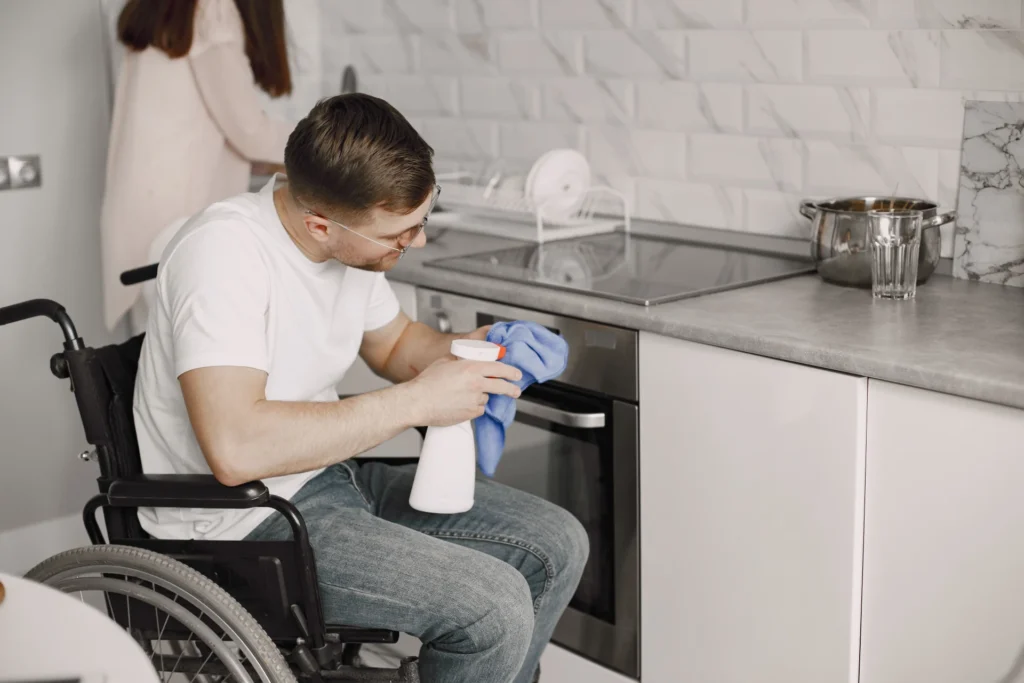
If you or someone you support lives with a disability and is finding it hard to keep on top of household cleaning, you may be able to access cleaning support through the National Disability Insurance Scheme (NDIS).
It sounds straightforward, but navigating NDIS funding categories, understanding what’s covered, and finding the right provider can feel like a lot to work through. This guide explains how NDIS cleaning services work in plain language, who can access them, what’s covered, and what to expect when you book.
Can NDIS Fund Cleaning Services?
Yes. Domestic cleaning is a funded support under the NDIS for participants whose disability affects their ability to perform household tasks independently or safely.
The NDIS isn’t means-tested like many government services. It’s needs-based. If your disability directly impacts your capacity to clean your home, and that need isn’t being met by informal support (family, friends, or other community services), the NDIS can fund professional cleaning support.
Not every participant will have cleaning included in their plan. It depends on your individual goals, your support needs assessment, and how your plan is structured. If you think cleaning support should be in your plan but it isn’t, this is worth raising with your Support Coordinator or NDIS planner at your next plan review.
Which NDIS Support Category Covers Cleaning?
NDIS house cleaning typically falls under Assistance with Daily Life, which is part of the Core Supports budget in a participant’s NDIS plan.
Specifically, cleaning is usually funded under:
Support Category 01: Assistance with Daily Life
This category covers supports that help participants with everyday tasks they find difficult because of their disability. Domestic cleaning, vacuuming, mopping, bathroom cleaning, kitchen cleaning, and general household tasks all fall under this category.
The relevant line item is typically Assistance with Daily Activities (Standard) or House Cleaning, depending on how your plan is set up.
Support Category 02: Household Tasks
Some participants have a separate Household Tasks allocation in their plan, which can cover cleaning, lawn mowing, and other domestic activities.
The category your cleaning support sits under depends on how your individual plan is structured. If you’re unsure, your Support Coordinator can clarify this.

Self-Managed, Plan-Managed, or Agency-Managed?
How you access and pay for cleaning under NDIS depends on how your plan is managed.
| Management Type | How It Works for Cleaning |
| Agency managed (NDIA managed) | You must use NDIS-registered providers. Your provider is paid directly by the NDIA. |
| Plan managed | A plan manager handles payments. You can use both registered and unregistered providers. |
| Self-managed | You manage your own funding and can use any provider you choose, registered or not, as long as the service is reasonable and necessary. |
If you’re agency-managed, it’s important to confirm that any cleaning provider you’re considering is NDIS-registered before booking. NDIS cleaning providers who are registered have been assessed against NDIS Quality and Safeguards Commission standards.
If you’re plan-managed or self-managed, you have more flexibility in choosing a provider, but the support still needs to meet the NDIS’s “reasonable and necessary” criteria.
What Does “Reasonable and Necessary” Mean?
The NDIS uses the “reasonable and necessary” test to determine what can be funded. For cleaning support to meet this test, it generally needs to be:
- Related to your disability: The difficulty cleaning needs to be a direct result of your disability, not just a lifestyle preference.
- Not already covered: The support shouldn’t duplicate something already provided through informal support, another government program, or another funded service.
- Value for money: The cost should be appropriate for the service being provided.
- Appropriate for your situation: The type of support should match your actual needs.
This doesn’t mean your disability needs to completely prevent you from cleaning. If your disability means cleaning causes pain, takes significantly longer than it should, creates a safety risk, or causes fatigue that affects your ability to manage your broader daily life, that can be enough to justify the support.
What NDIS Cleaning Services Can Cover
NDIS house cleaning support can cover a range of domestic tasks, depending on what’s included in your plan. Common supports include:
General domestic cleaning:
- Vacuuming and mopping floors
- Bathroom and toilet cleaning
- Kitchen cleaning (benchtops, sink, stovetop)
- Dusting and wiping surfaces
- Emptying bins
Laundry:
- Washing, drying, and folding laundry (where this is part of your funded support)
Other household tasks (where specifically funded):
- Ironing
- Changing bed linen
- Basic tidying
What NDIS cleaning typically does not cover:
- Deep cleaning or specialised cleaning beyond a standard domestic scope
- End of lease cleaning (this is a tenancy-related expense, not a disability support)
- Cleaning services not directly related to your disability support needs
If you have specific needs beyond standard cleaning (for example, if your disability requires particular hygiene standards or cleaning protocols in your home), these can sometimes be accommodated within your plan if properly documented.
How to Get Cleaning Support Added to Your NDIS Plan
If cleaning support isn’t currently in your plan, here’s how to work toward having it included.
Step 1: Document your needs
Write down specifically how your disability affects your ability to clean. Be concrete: “I have limited mobility in my hands and cannot safely use a mop” or “fatigue from my condition means I cannot complete cleaning tasks without rest, which takes the whole day.” The more specific you are, the stronger your case.
Step 2: Get supporting evidence
A letter or report from your treating professional (GP, occupational therapist, physiotherapist) that specifically describes how your disability impacts your ability to manage household tasks strengthens your plan review request significantly.
Step 3: Raise it at your plan review
Plan reviews are the right time to request changes to your funded supports. Bring your documentation and be clear about what you need and why.
Step 4: Work with a Support Coordinator
If you have a Support Coordinator in your plan, they can help you prepare for the review and advocate for the support you need.
What to Expect When You Book NDIS House Cleaning
Booking NDIS house cleaning for the first time can feel unfamiliar. Here’s what the process typically looks like with a professional provider.
- Initial contact: You (or your Support Coordinator or carer) contact the cleaning provider to discuss your needs, your plan management type, and the support you’d like.
- Service agreement: Registered NDIS cleaning service providers are required to have a service agreement in place before delivering supports. This outlines the services to be provided, the frequency, the cost, and the NDIS line items being claimed against. Read it carefully before signing.
- Your first clean: A good provider will take time on the first visit to understand your home, your preferences, and any specific requirements. If you have sensitivities to certain products, mobility considerations that affect how the cleaner should move around your home, or particular areas of priority, communicate these upfront.
- Ongoing support: Most participants arrange regular cleaning on a fortnightly or weekly basis. Consistency matters, and a reliable provider will send the same cleaner where possible so they know your home and your preferences.
- Claiming and payment: If you’re agency-managed, the provider claims directly from the NDIS. If you’re plan-managed, invoices go to your plan manager. If you’re self-managed, you pay the provider and submit claims yourself through the myNDIS portal.
Choosing the Right NDIS Cleaning Provider in Geelong
Not all cleaning providers understand the specific requirements of delivering support under the NDIS.
When comparing providers, it’s worth asking:
- Are you NDIS-registered? (Required for agency-managed participants)
- Do you have experience supporting participants with [specific disability or condition]?
- How do you handle scheduling changes or cancellations?
- Will the same cleaner come each time?
- What products do you use, and can you accommodate sensitivities?
- How do you communicate with Support Coordinators or carers where relevant?
A provider who takes time to answer these questions properly is demonstrating the kind of attention and professionalism that matters when delivering disability support.
Vacmate provides NDIS approved cleaning services across Geelong, the Bellarine Peninsula, and the Surf Coast. We work with participants across all plan management types and are happy to liaise with Support Coordinators and carers to make the process as straightforward as possible.If you’d like to talk through what support might look like for your situation, call us on (03) 7050 2742 or email info@vacmate.com.au.

Ajay moved to Geelong for his Master's in 3D Printing at Deakin University, fell for the region, and inspired by his parents' entrepreneurial spirit, made it home and launched Vacmate Cleaning. Over four years he's built a reliable, customer-focused service and a supportive team, leading with a passion for excellence and real connections with clients and staff. Outside work, he enjoys reading, driving, travelling, and meeting new people.